
INSIGHTS
Technical Explainers: Breaking Down Complex AV Systems for Modern Venues
Modern AV systems are no longer isolated technologies. Audio, video, lighting, control, and network infrastructure now operate as a unified, IP-based ecosystem.
For architects, engineers, and venue owners, the challenge is no longer selecting equipment—it’s understanding how systems interact, where bottlenecks occur, and how design decisions impact long-term performance.
This article breaks down core AV architectures, signal flow, and infrastructure strategies used in large-scale deployments, with a focus on clarity, scalability, and real-world implementation.
Understanding the Systems Behind the Experience
Audiences experience sound, video, and lighting as a seamless environment. Behind that experience is a layered system architecture where multiple technologies operate simultaneously and in real time.
AV system architecture decisions, particularly those involving signal flow, equipment location, and infrastructure pathways, must be made during the architectural design phase to avoid costly rework later.
At a minimum, modern AV systems rely on:
- Networked audio distribution (Dante, AES67, AVB)
- IP-based video transport (SDVoE, NDI, SMPTE ST 2110)
- Centralized control systems (Crestron, Q-SYS, AMX)
- Time synchronization across devices (PTP / IEEE 1588)
- Monitoring and diagnostics layers for system health
Each layer introduces latency, bandwidth requirements, and failure points that must be accounted for during design.
The goal of technical design is not simplification—it is coordination.
Systems must be engineered so that:
- Audio remains phase-coherent across zones
- Video latency stays within acceptable thresholds for live production
- Control systems respond in real time without conflict
- Network traffic is predictable and isolated
Understanding these relationships early prevents cascading issues during commissioning and operation.

The Shift Toward Networked AV Infrastructure
Distributed audio, video, and control systems now operate over shared network infrastructure, enabling scalable, multi-zone deployments across large venues.
Traditional AV systems relied on dedicated signal paths: one cable per signal, fixed routing, and hardware-defined workflows.
Modern systems replace this with packet-based transport over managed networks, where audio, video, and control signals coexist with IT traffic.
This shift introduces both flexibility and complexity.
Key drivers:

AV over IP replacing matrix switchers with multicast distribution
Convergence with enterprise IT networks requiring VLAN segmentation and QoS
Increased bandwidth demands from uncompressed or lightly compressed video
Distributed environments where endpoints span multiple physical spaces
The result is a system that is no longer defined by hardware topology, but by network architecture and configuration.
Designing these systems requires coordination with IT teams and an understanding of switching, routing, and traffic management—not just AV hardware.
How Integrated AV Systems Work

Display Systems Within the Media Layer
Large-format display systems—including LED walls and projection—are part of the media layer, where content is processed, distributed, and rendered across the venue. Each approach introduces different requirements for brightness, latency, signal transport, and infrastructure support.
Modern AV systems are built as layered architectures, where each layer performs a distinct function but depends on the others.
1. Network Layer
Provides bandwidth, routing, and segmentation for all AV and control data.
Design considerations include redundancy (LAGs, ring topologies), QoS policies, and multicast management.
2. Media Layer
Processes and transports signals:
- DSPs for audio processing
- Encoders/decoders for video distribution
- Playback servers and content systems
This layer determines latency, quality, and synchronization.
3. Control Layer
Acts as the orchestration engine:
- Routes signals
- Triggers events
- Automates system behavior
Poor control design often leads to operator confusion and system inefficiency.
4. User Interface Layer
Where humans interact with the system:
- Touch panels
- Software dashboards
- Control consoles
A well-designed UI reduces training requirements and minimizes operational errors.
Failure in any one layer can compromise the entire system, which is why integration—not just equipment selection—is the defining factor in system performance.
BEST PRACTICES
Design Principles for Scalable AV Systems
Scalable AV systems are not defined by size, but by their ability to evolve without redesign. This requires intentional engineering decisions at the infrastructure level.
Designing for scalability
Systems must allow additional endpoints (displays, speakers, cameras) without reconfiguring core infrastructure
Network segmentation
AV traffic should be isolated using VLANs to prevent interference from other data services.
Redundancy planning
Critical signal paths and network switches must include failover strategies to maintain uptime.
Standardization
Using consistent platforms reduces integration complexity and simplifies long-term maintenance.
Monitoring and diagnostics
Real-time visibility into system performance allows proactive issue detection and faster troubleshooting.
These practices allow venues to support evolving technologies while minimizing operational disruption.
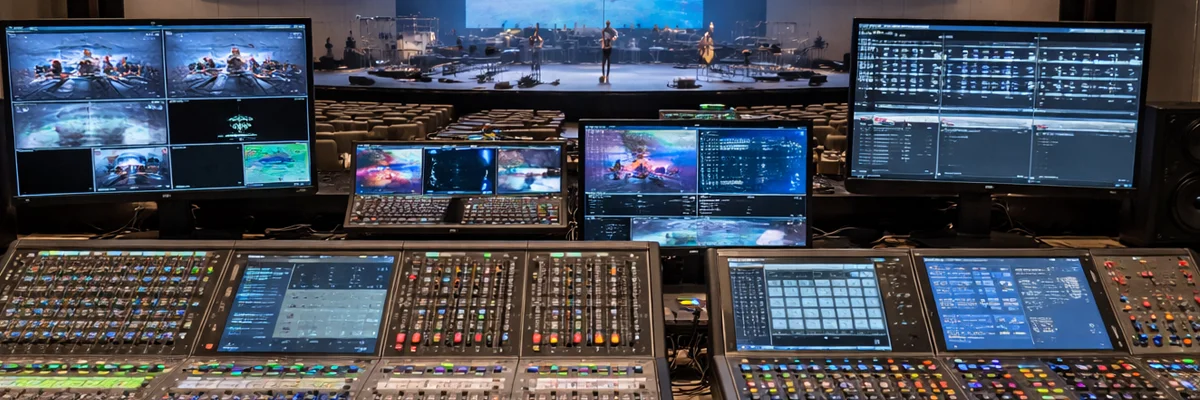
APPLICATIONS IN REAL-WORLD VENUES
Where These Systems Matter Most
The complexity of AV infrastructure becomes most visible in environments where multiple systems must operate simultaneously without failure.

Stadiums and arenas
- Distributed control rooms
- Real-time video routing and replay
- Large-scale audio zoning

Convention centers
- Multi-room signal distribution
- Flexible room configurations
- Centralized AV-over-IP backbones

Houses of worship
- Low-latency audio/video synchronization
- Multi-camera broadcast workflows
- Integrated lighting and media systems
THE FUTURE
Preparing AV Infrastructure for the Next Decade
AV infrastructure is increasingly defined by software, networks, and data—not fixed hardware systems.
Key trends shaping the next decade:
- Adoption of IP-native video workflows (SMPTE ST 2110, NDI)
- Software-defined routing replacing fixed switching hardware
- Cloud-based production and remote management tools
- Increased reliance on analytics for system optimization
Designing with these trends in mind ensures systems remain adaptable without requiring full infrastructure replacement.
Explore More AV Engineering Insights
Understanding system architecture is only the starting point.
Explore additional technical insights covering:
- Signal flow and system design
- Networked media workflows
- Broadcast and production infrastructure
Start Your Project
Explore More Insights