
INSIGHTS
Standards & Best Practices for Reliable AV Systems
AV systems today operate as part of a larger infrastructure—networked, distributed, and expected to perform continuously. Reliability is no longer a function of individual components, but of how the system is designed.
This page focuses on the standards and engineering practices that define long-term performance. These are the decisions that determine whether a system remains stable, scalable, and supportable years after deployment.
Why Standards Define System Performance
In large-scale AV environments, systems are expected to operate continuously, adapt to changing requirements, and integrate with broader building infrastructure.
Without defined standards:
- Systems evolve inconsistently
- Performance becomes unpredictable
- Troubleshooting depends on institutional knowledge
With defined standards:
- System behavior is consistent across environments
- Expansion follows a predictable path
- Failures can be isolated and resolved quickly
Standards are not documentation—they are the framework that keeps systems functional over time.

Designing for Scalable Architecture
AV systems should be structured to expand without reconfiguration of the core infrastructure.
Design requirements:
- Backbone bandwidth sized beyond initial deployment
- Distributed architecture (IDF/MDF planning)
- Defined signal paths and routing hierarchy
- Physical and logical capacity for additional endpoints
What happens without this?
- Systems grow unevenly
- Bandwidth bottlenecks appear in critical paths
- Expansion introduces instability
A scalable system is not simply larger. It is organized to evolve without disruption.

Network Segmentation & Infrastructure Discipline

AV systems rely on network performance, not just connectivity.
Core practices:
- VLAN segmentation for AV traffic types
- QoS policies for latency-sensitive streams
- Managed multicast (IGMP snooping and queriers)
- Defined IP schema and naming conventions
Coordination with IT must include:
- Security and access control policies
- Switch configuration standards
- Firmware lifecycle alignment
Failure to implement these results in:
- Intermittent audio/video issues
- Control instability
- Network congestion affecting multiple systems
AV must be engineered as a networked application—not an isolated system.
DESIGN PRINCIPLES
Redundancy Must Be Applied Where Failure Has System-Level Impact
Areas to address:
- Signal path redundancy
- Network topology (redundant switches, ring structures)
- Power redundancy (UPS, dual supplies)
- Control system fallback modes
Define clearly:
- What must remain operational
- Acceptable downtime
- Recovery process visibility
Without redundancy:
- A single failure can impact entire zones
- Recovery is slow and unclear
- Live environments become high-risk
Redundancy is not universal, but it must exist where failure is not acceptable.

OPERATIONAL CONTEXT
Where These Systems Matter Most
Focus is not on features, but on maintaining predictable performance under load.
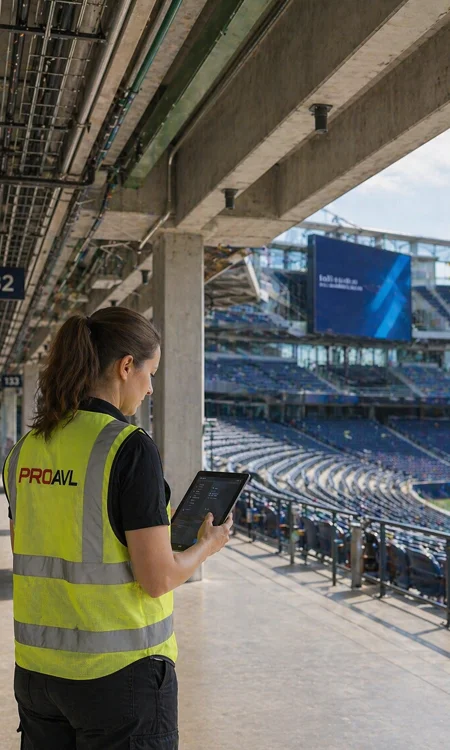
Stadiums and arenas
- Distributed AV across large physical areas
- High dependency on network performance
- No tolerance for system-wide failure
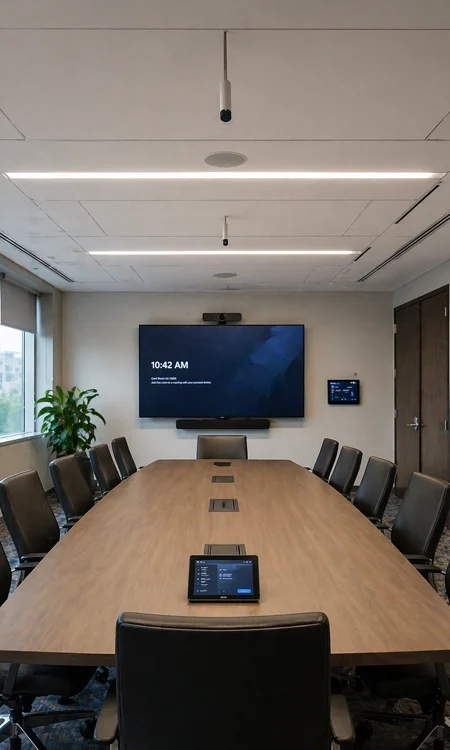
Corporate Environments
- Integration with enterprise IT systems
- High uptime expectations
- Frequent reconfiguration of spaces

Houses of worship
- Mixed operator skill levels
- Need for consistent, repeatable operation
- Broadcast and in-room systems combined
DESIGN CONSIDERATIONS
Long-Term Performance Is Defined During Design
System reliability is rarely determined during operation—it is the result of decisions made during system design.
Common failure sources:
- Incomplete coordination between disciplines
- Inconsistent infrastructure standards
- Undefined ownership of network and control layers
Systems that remain stable over time are characterized by:
- Structured architecture
- Defined standards across all layers
- Clear expansion pathways
These are not enhancements. They are baseline requirements.
Closing Note
If you’re planning a system that must scale, integrate with existing infrastructure, or operate continuously, these standards should be addressed early in the design process.
Most long-term issues are not caused by equipment—they originate from decisions made before installation begins.
Start Your Project
Explore More Insights