
INSIGHTS
Designing the Connected Venue: Why Interfaces Now Determine System Performance
The Real Test Happens Between Systems
A venue can look technologically complete and still feel difficult to operate.
The displays may be bright. The audio system may have coverage. The lighting may be capable. The control system may technically reach every required device. But when a production team needs an unexpected feed, when a room has to change formats quickly, or when an operator cannot tell which subsystem is causing a failure, the real design quality becomes visible.
That is where connected venue performance is decided.
Not in the specification of one display, processor, fixture, camera, or switch. Not in the isolated performance of a single system. It is decided in the handoffs: AV to IT, lighting to broadcast, control to operations, architecture to infrastructure, and event production to the systems that support it.
The best venues are not simply equipped. They are organized.
They give signals a clear path. They give operators a clear workflow. They give production teams access without improvisation. They give owners infrastructure that can adapt without being rebuilt every time the use case changes.
A connected venue is designed around those relationships from the beginning.
The Integration Layer Is Where Performance Lives
Venue technology is often discussed by category: audio, video, lighting, control, broadcast, networking, signage, and production. That makes sense during procurement, but it can be misleading during design.
Events do not experience those systems separately.
A keynote may need room audio, confidence monitoring, presentation switching, camera feeds, streaming, stage lighting, recording, lobby signage, and remote participant support at the same time. A live performance may need production lighting, show control, backstage communication, audience displays, broadcast splits, and low-latency monitoring. A press conference may need clean audio, camera-friendly lighting, multiple outputs, translation support, recording, and fast room reset.
The venue succeeds only when those systems behave as one environment.
That requires deliberate planning around:
- How audio, video, lighting, control, and network systems exchange information
- Which systems share infrastructure and which need separation
- Where production teams can access signals without temporary workarounds
- How event modes are selected, protected, and restored
- Who owns support when an issue crosses technical boundaries
The integration layer is not an afterthought. It is the framework that determines whether the venue performs smoothly under pressure.
Interfaces Are Design Decisions, Not Details
The weakest parts of a venue system are often the least visible.
A missing conduit. An overloaded network segment. A control page that exposes too many technical choices. A broadcast feed that exists in one room but not another. A rack location that complicates service. A lighting scene that works in person but creates problems on camera. A system status that only one person knows how to interpret.
These are not small details once the venue is live.
They shape the daily experience of the people who run the building and the teams who depend on it. They also shape the cost and complexity of future changes.
Critical interfaces:
- AV and IT — network design, security, bandwidth, latency, device management, and support ownership
- AV and broadcast — signal paths, audio splits, camera positions, production feeds, and recording workflows
- Lighting and camera systems — color, intensity, flicker control, contrast, and visual consistency
- Control and operations — user permissions, event modes, system monitoring, and operator confidence
- Architecture and infrastructure — sightlines, pathways, equipment rooms, cooling, power, rigging, and access
- Production and venue staff — guest requirements, technical riders, setup time, and escalation paths
When those interfaces are designed clearly, the system feels intentional. When they are left unresolved, the venue depends on workarounds.
Convergence Raises the Stakes
AV, IT, lighting, and broadcast systems used to be easier to separate. Today, the boundaries are much less clean.
A video system may depend on network routing. A signage platform may share infrastructure with control and monitoring. A lighting system may need to serve both audience experience and camera capture. A broadcast workflow may rely on in-room audio, presentation content, production comms, and network access. A control system may become the operational front door for multiple disciplines.
That convergence creates a more powerful venue, but also a more fragile one when planning is incomplete.
Shared infrastructure must be designed with clear rules. Traffic must be segmented appropriately. Support responsibilities must be understood. System behavior must be documented. Expansion capacity must be protected. Monitoring must show more than whether a device is powered on.
The objective is not to connect everything simply because it can be connected.
The objective is to create an infrastructure model where each connection has a purpose, a performance requirement, and an owner.

Event Modes Are the Practical Measure of Flexibility
Many venues ask for flexibility. Fewer define what flexibility actually means.
In real operation, flexibility is measured by how cleanly the venue can move between event types. A ballroom may need to support a corporate keynote in the morning, a streamed panel in the afternoon, and a private reception at night. A stadium may move from sports presentation to concert production to broadcast media obligations. A worship facility may support services, overflow rooms, livestreams, classes, and community events from the same infrastructure.
Each mode changes the technical requirements.
Audio routing changes. Lighting scenes change. Displays change. Camera needs change. Recording paths change. Control access changes. Staffing changes. Sometimes the room changes physically as well.
A connected venue turns those recurring scenarios into planned system behavior.
That means defining:
- Standard event modes
- Required signal paths for each mode
- Operator controls and permissions
- Presets, defaults, and recovery states
- Production access points
- Support escalation paths
- Documentation for repeatable setup
Flexibility should not depend on the most experienced person being in the building.
It should be built into the system.
OPERATIONAL REALITY
The Operator Experience Is Part of the System

A venue system is not finished when the equipment works. It is finished when the right people can use it correctly under real conditions.
That distinction matters.
Operators are often working under time pressure. Presenters change inputs. Production teams request feeds. Lighting needs adjustment. A room must reset. A stream has to start. A sponsor asset needs to appear in the correct location. A device fails minutes before doors open.
In those moments, complexity has to be managed by the design, not pushed onto the operator.
Strong connected venue design considers:
- Which users need access to which functions
- Which controls should be simplified, locked, automated, or hidden
- How operators confirm that the correct mode is active
- How system status is displayed
- How failures are identified and escalated
- How temporary production teams interact with permanent venue systems
- How staff are trained after turnover or role changes
The control interface should not be a map of the technology rack. It should be a map of the venue’s real workflows.
When the system is designed around the operator, the venue becomes easier to run, easier to support, and less dependent on institutional memory.
Commissioning Should Prove the Venue, Not Just the Equipment
A connected venue needs more than component testing.
It is not enough to confirm that displays power on, speakers pass signal, lighting scenes recall, cameras send video, or touch panels trigger commands. Those tests matter, but they do not prove that the venue is ready for the complexity of actual events.
The better question is: can the venue execute its real use cases predictably?
Workflow commissioning should test scenarios such as:
- Moving from presentation mode to broadcast mode
- Routing a presenter feed to in-room displays, recording, streaming, and overflow areas
- Supporting camera capture without compromising the in-room lighting experience
- Giving a visiting production team the access they need without exposing critical systems
- Recovering from a device failure without losing control of the event
- Restoring the venue to a known default state after a custom setup
- Verifying that documentation matches the installed system
This is where assumptions get exposed.
If commissioning only checks devices, the project may pass while the venue still struggles. If commissioning tests workflows, the owner gets a much clearer picture of operational readiness.
Documentation Is Infrastructure
Documentation is often treated as closeout material. In a connected venue, it should be treated as part of the system.
The reason is simple: integrated systems have dependencies. When a problem occurs, support teams need to understand not only what was installed, but how the pieces relate to each other.
Useful documentation should answer practical questions:
- Where does this signal originate?
- What systems does it touch?
- Which network does it use?
- Who has permission to change it?
- What is the expected behavior in each event mode?
- What should the operator check first if it fails?
- What capacity exists for future expansion?
This information becomes especially important after staff changes, vendor transitions, system upgrades, or emergency troubleshooting.
A connected venue without clear documentation is difficult to own.
The system may work on day one, but long-term performance depends on whether the owner can understand, maintain, and adapt it after handoff.
Coordination Has to Produce Technical Clarity
Coordination is valuable only when it changes the quality of the design.
Meetings alone do not solve interface problems. A project can have frequent coordination calls and still miss the technical dependencies that affect event performance.
The useful output of coordination is clarity:
- Clear system boundaries
- Clear signal responsibilities
- Clear network requirements
- Clear control logic
- Clear operating modes
- Clear infrastructure needs
- Clear ownership when issues cross disciplines
- Clear acceptance criteria before commissioning begins
Modern venue projects involve architects, consultants, engineers, IT teams, lighting designers, broadcast specialists, integrators, general contractors, facilities staff, and owner representatives. Each group sees part of the problem. The connected venue depends on translating those perspectives into one workable operating model.
That is where integration leadership matters.
Not as a generic promise to communicate, but as a disciplined process for turning overlapping requirements into a system that can be built, tested, operated, and supported.
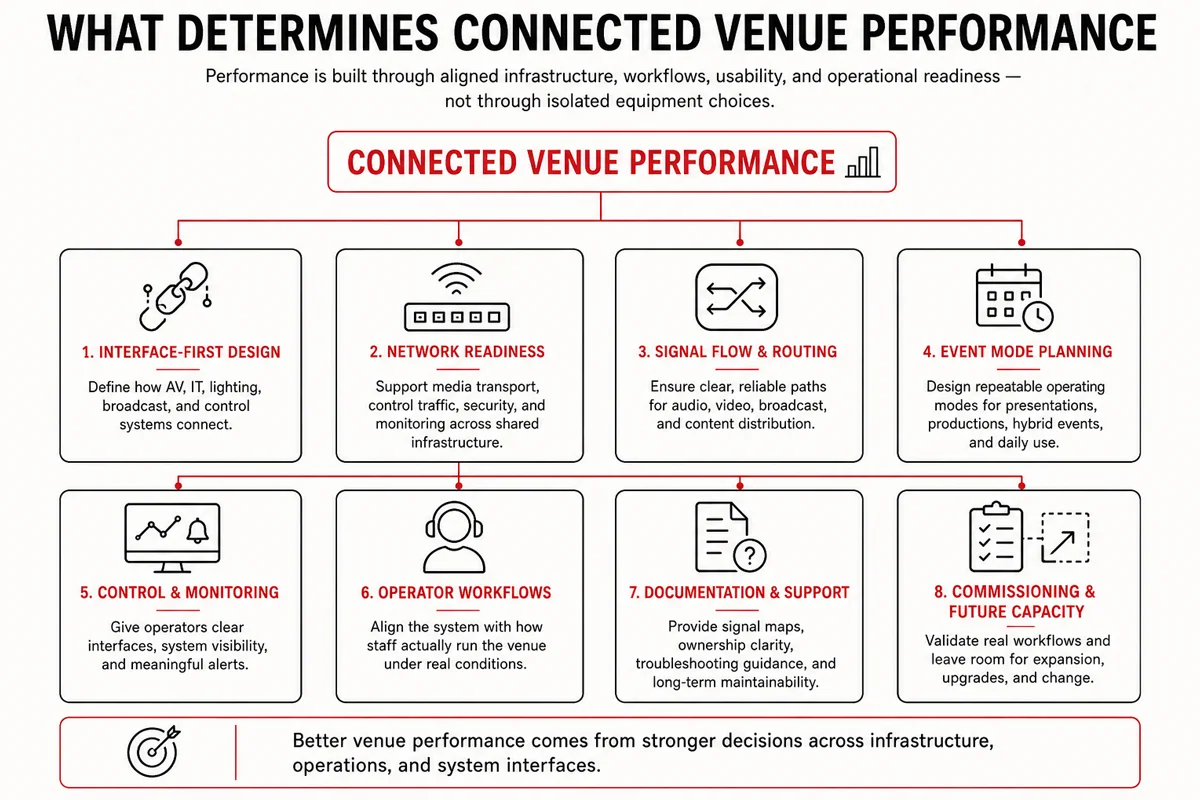
What Determines Connected Venue Performance
Across venue projects, performance is usually decided earlier than most teams realize.
It is decided when pathways are sized. When network strategy is defined. When broadcast requirements are captured. When control philosophy is agreed. When rack locations are selected. When event modes are documented. When service access is protected. When ownership between AV, IT, lighting, and operations is made explicit.
The final system is the result of those decisions.
High-performing connected venues are built around:
- Interface-first design
- Network architecture that supports media, control, and monitoring
- Planned event modes and workflow logic
- Production access without last-minute workarounds
- Lighting decisions that support both experience and capture
- Control systems organized around users, not equipment lists
- Documentation that supports real troubleshooting
- Commissioning based on operational scenarios
- Infrastructure capacity for future change
Better equipment can improve a system. But equipment cannot fully compensate for unclear interfaces, weak infrastructure, or undefined workflows.
When the connected layer is designed well, the technology becomes easier to use, easier to support, and easier to evolve.
Perspective
The connected venue is not a trend. It is the operating reality of modern event environments.
Audiences, presenters, broadcasters, sponsors, production teams, and venue staff all depend on the same technical foundation. Their needs overlap. Their workflows change. Their expectations continue to rise.
That makes isolated system thinking too limited.
A venue does not perform because its technology list is impressive. It performs because its systems have been planned as a working environment: connected where they should be connected, separated where they should be protected, documented where they must be supported, and flexible where the venue’s future requires it.
The difference between a venue with technology and a venue that performs is not cosmetic.
It is architectural.
And it is decided long before the first event begins.
Start Your Project
Explore More Insights